
Search Chatham County Divorce Records
Chatham County divorce records are held by the Superior Court Clerk in Savannah and include every divorce case filed in the county going back many decades. This guide covers how to find, request, and obtain Chatham County divorce records whether you need a certified decree, want to verify a filing date, or are searching historical cases through the court's online tools.
Chatham County Quick Facts
Where to Get Chatham County Divorce Records
The Chatham County Superior Court Clerk keeps all divorce records filed in the county. Clerk Tammie Mosley has served in this role since 2017. The main office sits on Montgomery Street in Savannah's downtown courthouse area, and the office handles both civil and domestic case files. For divorce specifically, staff direct most callers to press 1 for the Civil and Domestic division when they call the main line.
Under O.C.G.A. § 50-18-70, divorce records are public in Georgia unless sealed by court order. Sealed cases are uncommon, but they do occur when a judge finds a compelling reason to restrict access. If you are a party to the case, you can always access your own file. Third parties may request records so long as the case is not under seal.
| Court | Chatham County Superior Court |
|---|---|
| Address | 133 Montgomery Street Room 304, Savannah, GA 31401 |
| Phone | (912) 434-8920 |
| Hours | Monday through Friday, 8:00 AM to 5:00 PM |
| Website | https://superiorcourtclerk.chathamcountyga.gov |
There is also a satellite clerk's office at 1117 Eisenhower Drive, Suite C, Savannah, GA 31406. This location can serve residents on the south side of town without a trip downtown. Call ahead before visiting either location to confirm the record you need is available there and not archived at the main courthouse.
The Chatham County courthouse is in the heart of Savannah. Street parking exists nearby, and several public parking garages are within a short walk. If you arrive near the lunch hour, expect some delays as staff often take staggered breaks during peak times.
The screenshot below shows the Chatham County Superior Court Clerk's official website at superiorcourtclerk.chathamcountyga.gov, where you can find contact details, forms, and guidance on requesting divorce records.
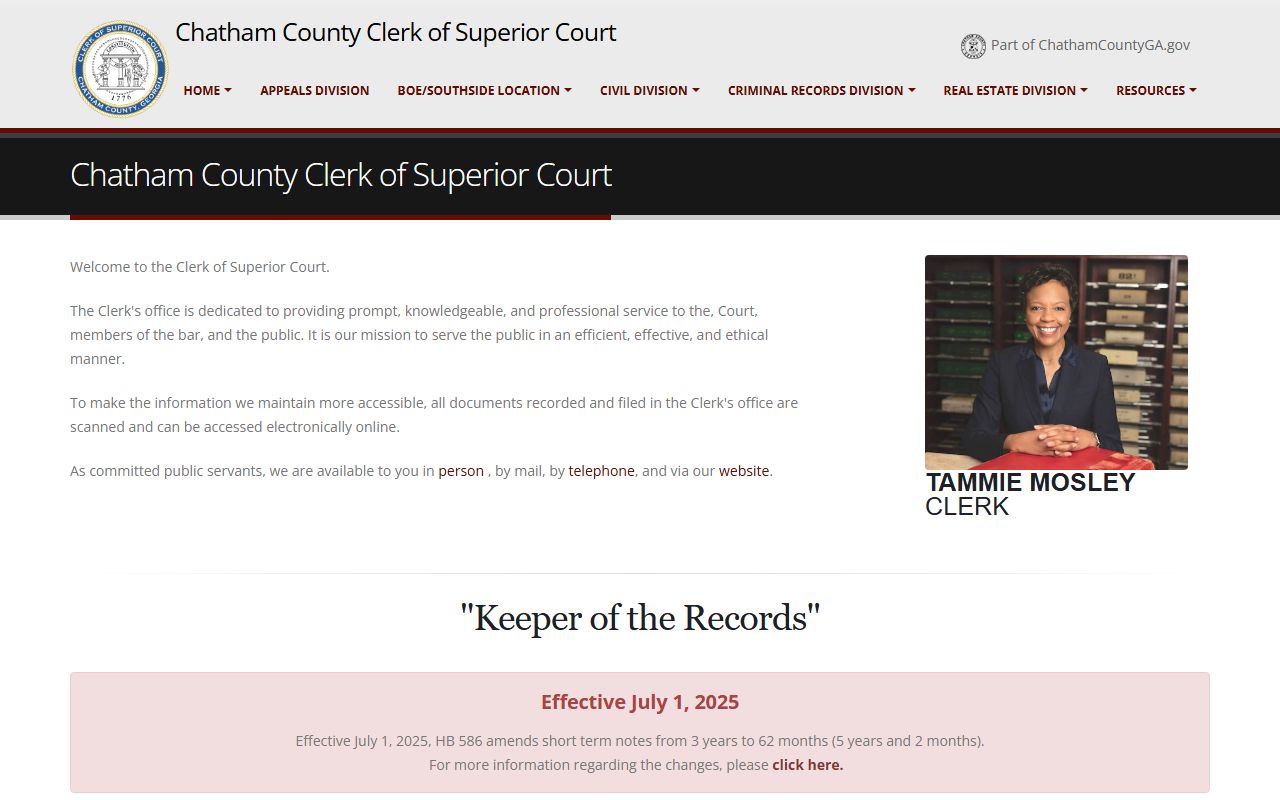
The clerk's website lists services, hours, and contact information for both the main office and the satellite location.
How to Search Chatham Divorce Records Online
Chatham County participates in the Georgia Superior Court Clerks' Cooperative Authority (GSCCCA) online search system. You can search Chatham divorce cases by name at gsccca.org. The portal shows filing dates, case numbers, and party names at no charge. Full document images may not be available for all cases, but the basic index is free and updated regularly.
The image below is taken from the GSCCCA portal showing the Chatham County clerk listing at gsccca.org/clerks/clerk-results?cid=25, which links directly to Chatham's records on the statewide system.
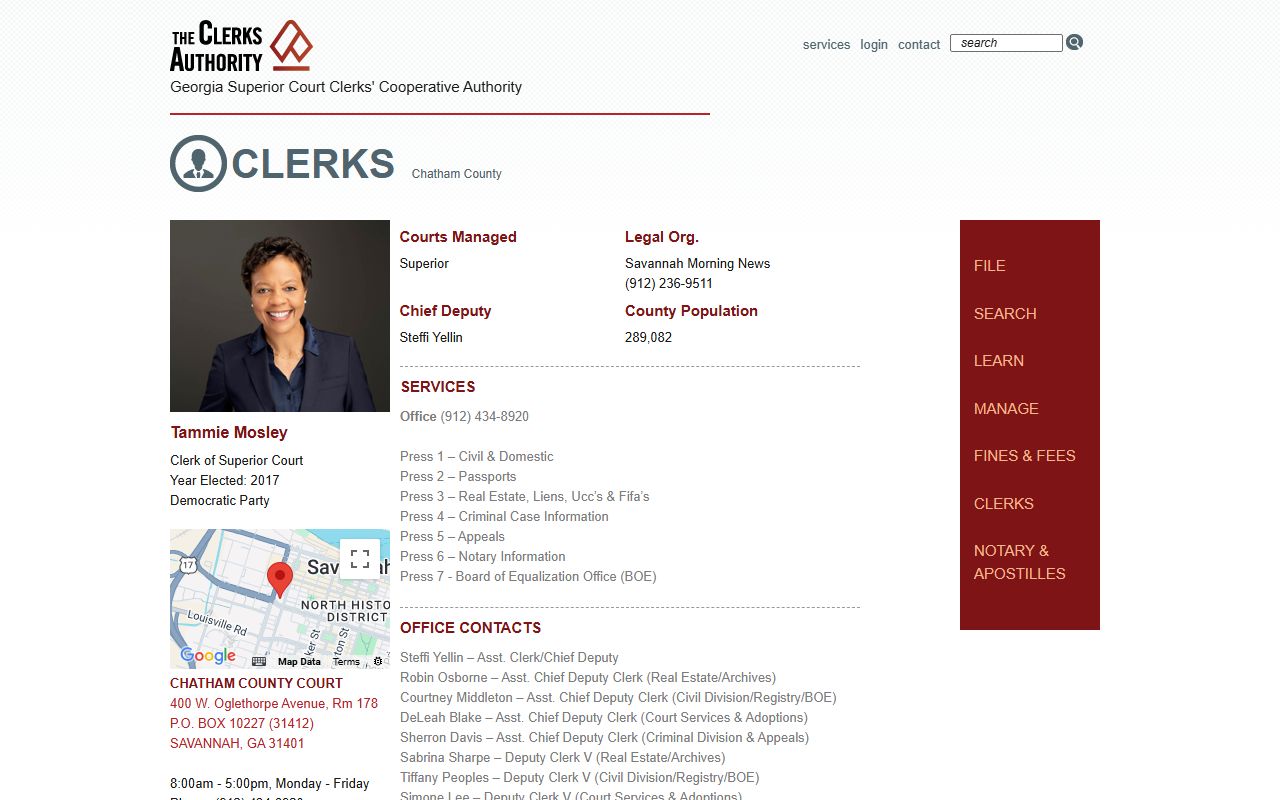
The GSCCCA portal is a good starting point before you visit or call the clerk's office, since knowing the case number speeds up every subsequent step.
Georgia E-Access at georgiacourts.gov/eaccess-court-records/ provides another layer of statewide court data. Together, GSCCCA and E-Access cover most cases filed electronically in Chatham County. For older paper-only records, you will need to contact the clerk directly and request a manual search.
Note: Case index data on GSCCCA may lag a few business days behind actual filings at the courthouse.
Chatham County Divorce Filing Process
All Georgia divorces go through the Superior Court. Under O.C.G.A. § 19-5-1, only the Superior Court has authority to grant a divorce in the state. In Chatham County, the Superior Court sits in Savannah and handles all domestic relations cases including contested and uncontested divorces.
Where you file depends on where the parties live. O.C.G.A. § 19-5-2 says you generally file in the county where the defendant resides. If your spouse lives in Chatham County, you file here regardless of where you live. If both parties live in Savannah, Chatham County is clearly the right venue. When the defendant has moved out of Georgia, you may be able to file in the county where you live instead.
Georgia requires a 30-day waiting period after the defendant is served before a divorce can be finalized. For an uncontested case where both spouses agree on all terms, the process can move fairly fast once that window closes. Contested cases, where the parties disagree on property, custody, or support, take longer and often require hearings before a judge.
The grounds for divorce in Georgia are defined by O.C.G.A. § 19-5-3, which lists both no-fault and fault-based grounds. Most modern divorces use the no-fault ground of irreconcilable differences, which requires no proof of wrongdoing by either party. Fault-based grounds such as adultery or desertion are still available but less commonly used today.
Once the judge signs the final decree, it is filed with the Chatham County Superior Court Clerk and becomes a public record. Parties receive a copy, and additional certified copies can be ordered from the clerk at any time after that.
Fees for Chatham County Divorce Records
Copy fees at the Chatham County clerk vary by what you need. Plain copies of divorce documents cost less than certified copies, which carry the court's official seal and signature and are required for legal purposes like remarrying or changing a name with a government agency.
For divorce decrees finalized between 1952 and 1996, the Georgia Department of Public Health (DPH) Vital Records office also maintains a verification service. DPH at dph.georgia.gov/VitalRecords charges $10 per verification. Keep in mind that DPH provides a verification letter, not a certified copy of the actual decree. If you need the full decree document, you still have to get it from the Superior Court Clerk.
Under O.C.G.A. § 31-10-22, court clerks are required to file monthly reports with DPH on all divorces finalized in the county, which is how that state database was built. This reporting is ongoing, so DPH records continue to grow beyond the 1952-1996 window, though the verification service currently focuses on that earlier period.
Call the clerk at (912) 434-8920 to get the current fee schedule before you visit or send a mail request. Fees can change, and having the right payment ready avoids delays.
Note: The clerk accepts personal checks, money orders, and most major credit cards, but confirm accepted payment methods when you call.
Legal Resources in Chatham County
If you cannot afford an attorney, Georgia Legal Aid serves Chatham County residents with low-cost and free civil legal services. Their office can help with uncontested divorces, child support modifications, and other domestic matters. There are income limits to qualify, but the application process is straightforward and staff are used to helping people who are filing without a lawyer.
The Georgia State Bar's lawyer referral service connects you with a licensed attorney for a reduced-cost initial consultation. You can reach the referral service through the State Bar's website. For people handling their own case, the Georgia E-Forms project provides free downloadable forms for uncontested divorces including the petition, settlement agreement, and final order. These forms are available through the Georgia judicial website.
Pro se litigants , people representing themselves , are common in Chatham County divorce court, particularly in uncontested matters. The clerk's office cannot give legal advice, but staff can tell you what forms to file and where to file them. Savannah also has a courthouse facilitator program that offers guidance on family law paperwork without the cost of full representation.
Divorce Certificates in Chatham County
There is a key difference between a divorce certificate and a divorce decree. The decree is the full court order signed by the judge, which spells out all the terms of the divorce. The certificate is a shorter document that simply confirms the divorce happened, listing names, dates, and the county where it was filed. For most everyday purposes, a certified copy of the decree is what you actually need.
Georgia DPH issues divorce verifications rather than traditional certificates. These cover cases from 1952 through 1996 and cost $10 each. You can request them through DPH's Vital Records office at dph.georgia.gov/VitalRecords. A verification confirms the divorce occurred but does not contain the property settlement, custody terms, or other details from the actual decree.
For a certified copy of the full Chatham County divorce decree, go directly to the Superior Court Clerk at 133 Montgomery Street. Certified copies carry the court seal and are accepted by the Social Security Administration, passport agencies, the DMV, and most financial institutions as proof of divorce. Plain (uncertified) copies work for personal reference but are not accepted for legal transactions.
If the divorce happened decades ago and you are not sure which county handled it, the GSCCCA name search can often pinpoint the county without you needing to know that detail upfront.
Nearby Counties
Chatham County borders several coastal and inland counties in southeast Georgia. If a divorce was filed in a neighboring county, use the links below to find that county's records office.