
Dodge County Divorce Records Search
Dodge County divorce records are on file at the Superior Court Clerk's office in Eastman, Georgia, and include every divorce case granted in this south-central Georgia county. This guide explains how to find and request Dodge County divorce records whether you prefer to search online, come in person, or mail a written request to the courthouse.
Dodge County Quick Facts
Where to Get Dodge County Divorce Records
The Dodge County Superior Court Clerk in Eastman is the official custodian of all divorce records for this county. All divorce petitions, case files, and final decrees are stored at the courthouse on Anson Avenue. If you need a certified copy or want to look up case details, this office is where you start. The clerk can search by name or case number and provide copies of the documents you need.
| Court | Dodge County Superior Court |
|---|---|
| Address | 5401 Anson Avenue, Eastman, GA 31023 |
| Phone | (478) 374-2871 |
| Hours | Monday through Friday, 8:00 AM to 5:00 PM |
| Website | https://www.dodgecountyga.com/ |
Georgia's Open Records Act, O.C.G.A. § 50-18-70, gives the public access to court records, including divorce filings. Most Dodge County divorce records are available to anyone who requests them. Cases sealed by the court are rare and typically involve sensitive matters related to minor children.
The screenshot below shows the Dodge County official site, which provides courthouse contact information and any posted service updates.
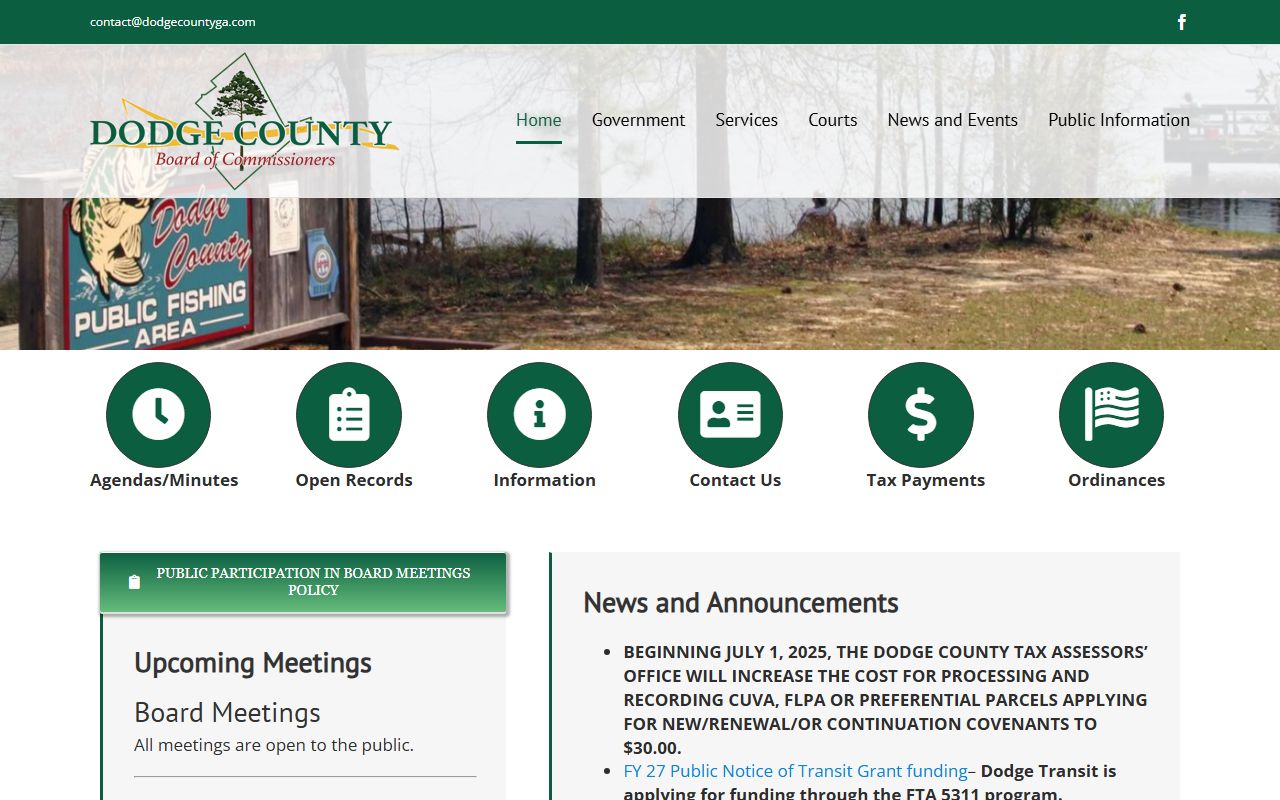
Check this site for any changes to office hours or access before traveling to Eastman from outside the county.
Call ahead if you are looking for older records. Pre-electronic files in Dodge County may be stored in an archive that requires staff time to retrieve. Having the parties' names and approximate filing year ready when you call speeds the process considerably.
How to Search Dodge County Divorce Records
The Georgia Superior Court Clerks' Cooperative Authority at gsccca.org is the best free online tool for searching Dodge County divorce records. Enter the name of either party to find case data including docket numbers, filing dates, and case status. The system covers many Georgia counties and is the first place to check before contacting the courthouse. Document images may not be available for all Dodge County cases, but the index data is enough to confirm a case exists and get the case number.
Georgia E-Access at georgiacourts.gov/eaccess-court-records/ is another statewide search option. If Dodge County participates, you may find more detailed case information there. Either portal can give you a case number before you request copies, which speeds up service at the clerk's office.
Mail requests are a practical option if you cannot visit Eastman in person. Write to the Dodge County Superior Court Clerk at 5401 Anson Avenue, Eastman, GA 31023. Include both parties' full names, the year of the divorce if known, your return address, and payment for the copy fee. A self-addressed stamped envelope is helpful. Call (478) 374-2871 first to confirm the current fee.
Note: Allow extra time for mail requests to older archived records, which may require additional research time by staff.
Dodge County Divorce Filing Process
Georgia law gives Superior Courts exclusive power over divorce cases. O.C.G.A. § 19-5-1 makes this clear. The Dodge County Superior Court in Eastman handles all divorces for county residents. Magistrate courts and other courts in the county have no jurisdiction to grant a divorce.
Venue rules under O.C.G.A. § 19-5-2 require filing in the county where the defendant lives. If your spouse lives in Dodge County, you file in Eastman. If your spouse lives elsewhere in Georgia, the case is filed in that county. This matters when searching records: the divorce file is wherever the case was originally filed, not necessarily in Dodge County.
Georgia provides 13 grounds for divorce under O.C.G.A. § 19-5-3. Irretrievable breakdown of the marriage is the most common choice, requiring no proof of fault from either party. Once the petition is filed in Eastman, the defendant must be served. A 30-day waiting period follows before the court can enter a final decree. If both parties agree on all issues, the case typically resolves as soon as the waiting period ends and all paperwork is properly submitted.
The final signed decree is recorded by the Dodge County clerk and held permanently. Anyone with a legal right to access the record can request a copy at any time after it is entered.
Dodge County Copy Fees and Costs
Copy fees at the Dodge County Superior Court vary by document type and whether you need a certified or plain copy. Call (478) 374-2871 to get the current per-page rate before visiting or mailing a request. Fees can change, and the clerk can give you an exact figure to include with your request.
If you only need to confirm a divorce occurred between 1952 and 1996, the Georgia Department of Public Health offers a $10 verification through its Vital Records office. The verification lists the names, date, and county but does not include the terms of the decree. For the full court order, you must request it from the Dodge County clerk. The DPH holds no copies of actual decrees for any period.
Divorces before 1952 or after 1996 are not covered by the DPH at all. The Dodge County Superior Court Clerk is the only source for those records.
Divorce Decrees vs. Certificates
A divorce decree is the judge's signed court order and the full legal record of the divorce. It contains every ruling the court made including property division, any spousal support ordered, custody terms, and child support amounts. The Dodge County Superior Court Clerk holds this document. It is the record most legal, financial, and government institutions want when they ask for proof of divorce.
A divorce certificate or state verification is held by the Georgia Department of Public Health only for divorces from 1952 through 1996. The cost is $10. It shows names, date, and county but no case terms. It is useful for basic administrative purposes but cannot substitute for the full court order when legal details are needed. For divorces outside the 1952 to 1996 range, the DPH holds nothing at all.
When in doubt, request the decree from the Dodge County clerk. It serves every purpose the DPH verification does and provides the binding legal terms of the divorce besides.
Note: Many people are surprised to find the DPH has no record for post-1996 divorces. All requests after that date go directly to the clerk.
Legal Help in Dodge County
Georgia Legal Aid at georgialegalaid.org covers Dodge County through its Middle Georgia regional office. Qualified low-income residents can get help with divorce, custody, and support cases. Their website has a case intake form and a self-help library with guides for common family law situations. Anyone can use the online resources regardless of income.
For people filing without an attorney, the Georgia E-Forms portal at eforms.georgiacourts.gov provides approved court forms for uncontested divorces. Using correct forms from the start avoids rejected filings. The Dodge County clerk can tell you which specific forms the local court requires alongside the state forms.
Clerks cannot give legal advice. For contested matters involving property disputes or child custody, a licensed family law attorney provides a significant advantage. The Georgia State Bar's lawyer referral service can match you with an attorney who handles cases in Dodge County.
Nearby Counties
Dodge County is surrounded by several middle and south Georgia counties. If a divorce was filed across the county line, records may be held in one of these neighboring counties.