
Find Divorce Records in Echols County
Echols County divorce records are held by the Superior Court Clerk in Statenville, Georgia, one of the smallest and most rural county seats in the state. All divorce cases filed in Echols County are stored at the courthouse in Statenville, and this guide explains how to locate and request those records whether you search online, contact the clerk by phone, or send a written request.
Echols County Quick Facts
Where to Get Echols County Divorce Records
The Echols County Superior Court Clerk in Statenville holds all divorce records for the county. Echols County is one of Georgia's smallest counties by population, located in the far south near the Florida state line. The courthouse is on Highway 129 South in Statenville. All divorce filings and decrees are stored at this office, and the clerk can search records by party name or case number.
| Court | Echols County Superior Court |
|---|---|
| Address | 110 Highway 129 South, Statenville, GA 31648 |
| Phone | (229) 559-5602 |
| Hours | Monday through Friday, 8:00 AM to 5:00 PM |
| Website | https://www.echolscountyga.gov/ |
Because Echols County is very small, the courthouse staff is limited. Call before visiting to make sure the records you need are accessible and that the office will be staffed that day. Staff sometimes have coverage limitations in very small county offices, and arriving without confirming ahead of time can mean a wasted trip. Having the full names of both parties and the approximate year of the divorce ready is especially helpful here.
Georgia's Open Records Act, O.C.G.A. § 50-18-70, makes divorce records public. Anyone can request access to Echols County divorce filings unless a specific case was sealed. Sealed cases are rare in any Georgia county and require a court order. Parties to the divorce always have the clearest right to their own case records.
The screenshot below shows the Georgia courts E-Access portal, which provides statewide case search functionality and may show Echols County cases.
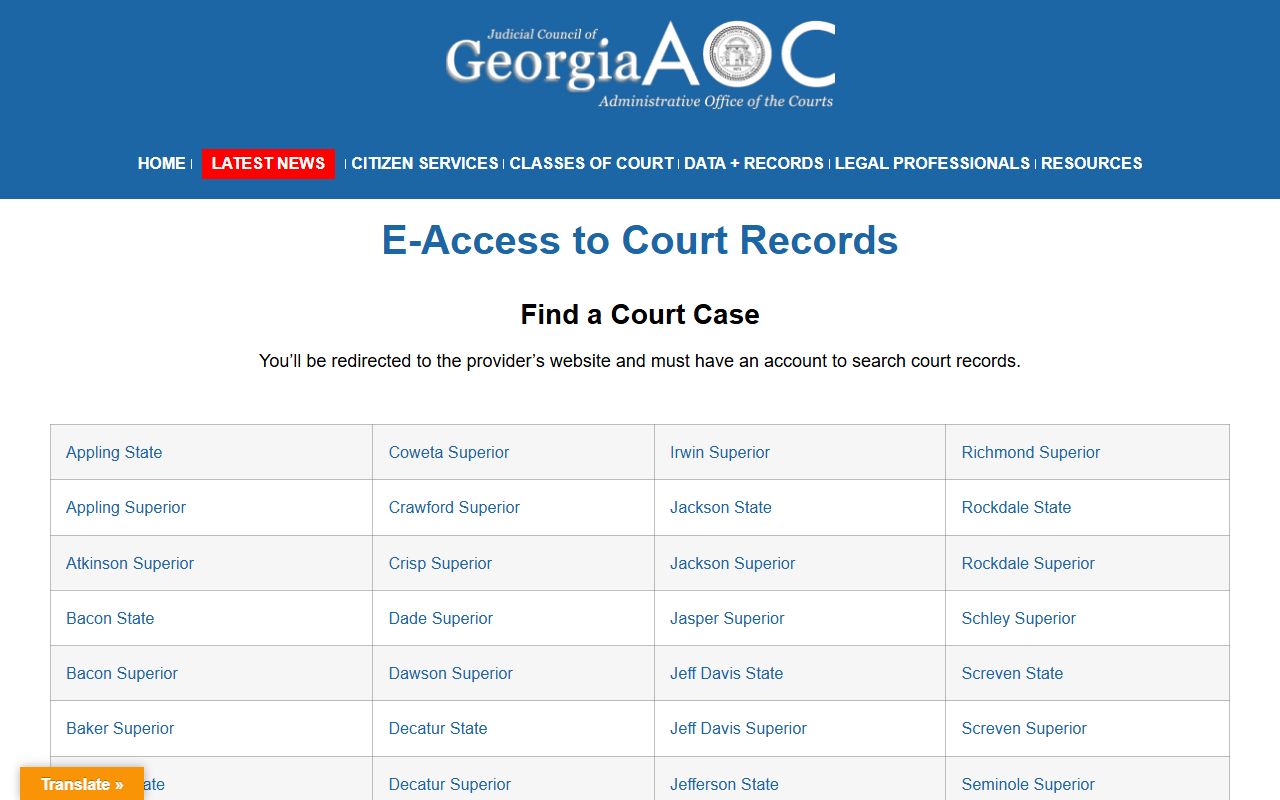
Use this portal to look for Echols County case data online before contacting the clerk's office directly.
How to Search Echols County Divorce Records
The Georgia Superior Court Clerks' Cooperative Authority at gsccca.org is the primary free statewide case search tool. Enter a party name to search Georgia Superior Court records, including Echols County. The index is free and requires no account. You can find the docket number, filing date, and basic case data. Not all older Echols County records may be fully indexed, but recent cases should appear.
Georgia E-Access at georgiacourts.gov/eaccess-court-records/ is an additional statewide portal. Try both systems when searching for an Echols County case. If you locate the case number online, use it when contacting the clerk to speed up the request significantly.
For mail requests, write to the Echols County Superior Court Clerk at 110 Highway 129 South, Statenville, GA 31648. Include both parties' names, the year of the divorce if known, your return address, and payment for the copy fee. A self-addressed stamped envelope is necessary for receiving documents by return mail. Call (229) 559-5602 first to confirm the current fee before sending anything.
Note: Because Echols County is so small, in-person visits sometimes work better than mail requests for getting a timely response on older records. Calling first is strongly advised either way.
Echols County Divorce Filing Process
Georgia law gives Superior Courts exclusive power to grant divorces. O.C.G.A. § 19-5-1 is the governing statute. The Echols County Superior Court in Statenville handles all divorce cases for county residents. It is a small court, but it carries full authority over every divorce filed in this county.
Venue is set by O.C.G.A. § 19-5-2. File in the county where the defendant lives. If your spouse lives in Echols County, you file in Statenville. If they have moved to another county, the case goes there. Many Echols County residents who moved away may have their divorce records in a larger neighboring county like Lowndes or Lanier rather than in Statenville.
Georgia's 13 grounds for divorce are listed in O.C.G.A. § 19-5-3. Irretrievable breakdown is the most common choice and requires no proof of fault. After a petition is filed and the defendant is served, a 30-day wait is required before a decree can be entered. In an uncontested case where both parties agree on all terms, the case often closes shortly after the waiting period once all documents are properly on file with the clerk.
The final decree is a permanent public record kept by the Echols County clerk. Certified copies can be ordered at any time after the decree is entered into the record.
Echols County Copy Fees and Costs
Copy fees at the Echols County Superior Court vary by document type. Certified copies cost more than plain ones. Call (229) 559-5602 before visiting or mailing a request to confirm the current rate. Echols County's small operation means it is especially important to confirm availability and fees before traveling or sending payment.
For divorces between 1952 and 1996, the Georgia Department of Public Health at dph.georgia.gov/VitalRecords provides a $10 verification. It confirms the divorce occurred but contains no terms of the decree. For the actual court order, request it from the Echols County clerk. The DPH holds no court decrees for any time period or county.
For divorces before 1952 or after 1996, the DPH has no record at all. Only the Echols County clerk can help for those dates.
Divorce Decrees vs. Certificates in Echols County
Two documents exist and they are very different. Getting the wrong one causes delays and forces you to start the process over with a different agency.
The divorce decree is the full judge-signed court order. It contains every legal ruling made in the case. Property division, debt assignments, spousal support, child custody, and child support are all in the decree. The Echols County Superior Court Clerk holds this document. Most legal purposes require the actual decree, not a summary. It can be ordered from the Statenville courthouse at any time after it is entered.
The state divorce verification from the Georgia Department of Public Health covers only 1952 through 1996. It costs $10 and provides just names, date, and county. No case terms are included. For anything outside that date range, the DPH has nothing. For any situation that requires legal proof of the divorce's terms, the court decree from Echols County is the right document.
Note: In a county as small as Echols, even a phone call to confirm which document you need can save a significant amount of travel time compared to driving to Statenville unprepared.
Legal Help in Echols County
Georgia Legal Aid at georgialegalaid.org serves Echols County through its South Georgia regional office. Qualifying residents can get help with divorce, custody, and support. Their website has an intake form and free self-help resources open to all users. Given the county's small size and limited local resources, Georgia Legal Aid is often the most accessible source of family law help for Echols County residents.
The Georgia E-Forms portal at eforms.georgiacourts.gov has official uncontested divorce forms that work in Georgia courts including Echols County. Using state-approved forms prevents the clerk from returning your filing. Call the clerk at (229) 559-5602 to ask about any additional local requirements for divorce filings in Echols County specifically.
For contested matters involving property or child custody, finding a licensed family law attorney through the Georgia State Bar's referral service is the most practical option. Attorneys familiar with the Alapaha Judicial Circuit, which includes Echols County, can advise on local court schedules and practices.
Nearby Counties
Echols County borders Lowndes County and Lanier County in Georgia, and Hamilton County in Florida. Divorce records for nearby residents may be held in one of these adjacent Georgia counties.