
Long County Divorce Records
Long County divorce records are kept by the Superior Court Clerk in Ludowici and cover all divorce cases filed in the county. If you need to locate a certified decree, search historical case files, or confirm whether a divorce was finalized, this guide walks you through every available option for accessing Long County divorce records through online tools, the Ludowici courthouse, and mail requests.
Long County Quick Facts
Where to Get Long County Divorce Records
All divorce records for Long County are held by the Superior Court Clerk in Ludowici. This office maintains the official case files from filing through final decree and any post-judgment matters. You can visit the courthouse on North Macon Street during regular business hours, contact the clerk by phone, or submit a written mail request for copies.
Under Georgia's open records law at O.C.G.A. § 50-18-70, court records are available to the public. No special legal standing is required to request a divorce record. If a file has been sealed by court order, which is rare in family law cases, the clerk will inform you of the restriction. Most Long County divorce records are open without any access limitation.
| Court | Long County Superior Court |
|---|---|
| Address | 47 North Macon Street, Ludowici, GA 31316 |
| Phone | (912) 545-2020 |
| Hours | Monday through Friday, 8:00 AM to 5:00 PM |
| Website | https://www.longcountyga.gov/ |
The courthouse is on North Macon Street in Ludowici. Long County is a smaller coastal plain county in southeast Georgia. The clerk's staff handle records requests from both local residents and those contacting from outside the county. Calling ahead before a visit helps confirm availability, particularly for older records that may need to be retrieved from storage.
The Long County government website shown below provides current contact information and links to court resources.
Current clerk contact information and court resources for Long County are available at longcountyga.gov.
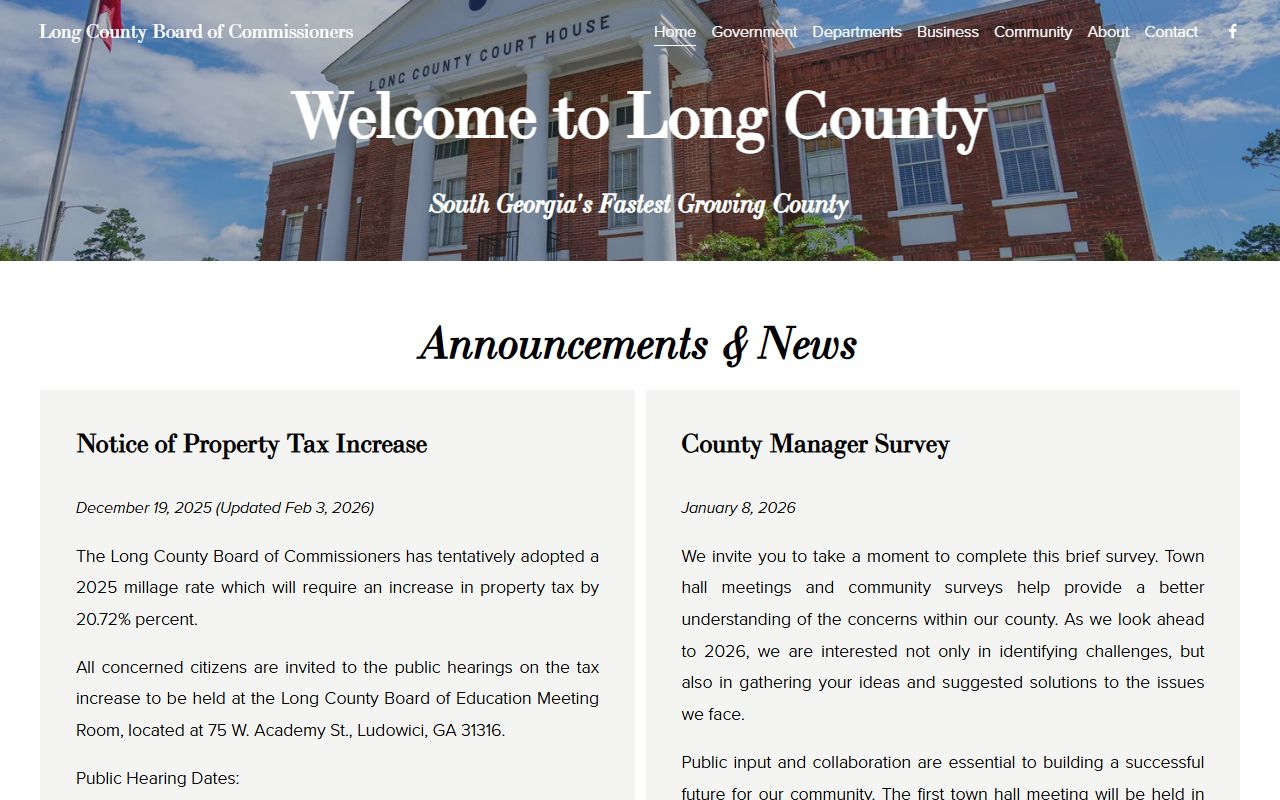
The Long County Superior Court Clerk in Ludowici maintains all county divorce records and handles public records requests for certified copies and case documents.
Note: Long County is one of Georgia's smaller counties, but the clerk maintains a complete archive of divorce records going back many years.
How to Search Long County Divorce Records
The Georgia Superior Court Clerks' Cooperative Authority at gsccca.org provides free online case searches. Long County records are included in this statewide system. Search by party name or case number to find basic case information, including filing date and status. Using the GSCCCA portal before contacting the clerk can save time by identifying the case number in advance.
Georgia E-Access at georgiacourts.gov/eaccess-court-records/ is a second tool for court records. Check both the GSCCCA and E-Access portals, as they may contain different data depending on how Long County uploads its records. If you find the case online, note the docket number before calling or visiting the Ludowici courthouse.
For older Long County records before electronic indexing, the clerk at (912) 545-2020 is the direct contact. Provide both party names and an approximate year of filing. Staff will search the archive manually. Research requests for older files may take a business day or two depending on how the records are stored.
Mail requests are processed by the clerk's office. Send your request with all identifying information and a money order for the estimated fee to 47 North Macon Street, Ludowici, GA 31316. Confirm the fee before sending.
Long County Divorce Filing Process
Georgia's residency requirement under O.C.G.A. § 19-5-2 requires that at least one spouse must have lived in Georgia for six months and in Long County for at least thirty days before filing. This threshold is mandatory before the Superior Court here can take jurisdiction. Missing it means the case must be refiled once the requirement is met.
Georgia divorce law at O.C.G.A. § 19-5-3 allows both no-fault and fault grounds. The no-fault ground that the marriage is irretrievably broken is the most common approach in Long County and across Georgia. It does not require proving any specific wrongdoing and is available to all couples. Fault grounds remain available and can sometimes affect how property or alimony is handled, but they require evidence and are far less frequently pursued.
After filing the petition, the respondent must be served. Service in Long County is typically carried out by the county sheriff or a private process server. The respondent then has thirty days to file a response. Georgia imposes a mandatory thirty-day waiting period from service before the final decree can be signed. This applies to all cases, including those where both parties are fully in agreement.
Uncontested Long County divorces tend to resolve efficiently after the waiting period. When disputes arise over property, children, or support, the timeline depends on how quickly the parties can reach resolution or how the court schedules any needed hearings.
Copy Fees for Long County Divorce Records
The Long County clerk charges per-page fees for copies of divorce documents. Plain copies cost less than certified copies. Certification adds the official court seal and clerk's signature and is necessary when presenting the decree to a government agency, financial institution, or out-of-state court. Order certified copies when you know official use is required to avoid a second trip or additional mail requests.
For divorces in the 1952 to 1996 period, the Georgia DPH offers a $10 verification search at dph.georgia.gov/VitalRecords. The DPH record is a summary that confirms the basic facts of the divorce but does not contain the terms of the court's order. It is useful for genealogical research and basic confirmation but is not a substitute for the certified court decree.
For divorces after 1996 or when you need the full court document, the Long County clerk is the sole official source. Call (912) 545-2020 before sending payment to confirm current fee amounts and acceptable payment methods.
Legal Resources in Long County
Residents of Long County who want to file for divorce without a lawyer can access free, court-approved forms through the Georgia Courts E-Forms portal at eforms.georgiacourts.gov. These Georgia Supreme Court-approved forms are designed for uncontested divorces and are appropriate for simple cases where both parties agree and there are no minor children or significant property issues to resolve.
Georgia Legal Aid at georgialegalaid.org provides free legal assistance to income-qualified residents, including those in Long County. Their online intake form is the first step. Legal Aid can help with forms, provide legal advice, or refer you to a local attorney if direct representation is available in the service area.
For contested cases, particularly those involving children or valuable property, consulting a licensed family law attorney before filing or signing any agreement is strongly recommended. The State Bar of Georgia's referral service can help you find an attorney who practices in the southeast Georgia judicial circuit covering Long County.
Note: Self-help forms work well for agreed cases, but if circumstances change after filing, having legal guidance available in advance prevents avoidable complications.
Divorce Decrees and State Certificates
Two distinct records document a divorce in Georgia. The Long County Superior Court decree is the court's official order. It contains all terms including property division, alimony, custody, and support. Certified copies come from the clerk in Ludowici and are the required documents for most legal purposes, including name changes, remarriage, and official benefit claims.
The Georgia DPH maintains a statewide divorce index under O.C.G.A. § 31-10-22. This is a summary record submitted by counties to the state. The DPH entry confirms the divorce occurred and gives the date and county, but it does not include the court's specific orders or terms. This record works for genealogical research or basic historical confirmation but is not a legal substitute for the certified court decree.
For most practical needs, the certified court decree is what you should request. It is the complete and authoritative document. The DPH record is a useful supplement but should not be substituted for the decree when the terms of the divorce need to be verified or proved.
Nearby Counties
Long County is in southeast Georgia near the coast. Cases near county borders may have been filed in one of the adjacent jurisdictions below.