
Clayton County Divorce Records Lookup
Clayton County divorce records are maintained by the Superior Court Clerk in Jonesboro, which serves as the official custodian of all domestic case files in the county including family division matters. This guide explains how to access Clayton County divorce records through the GSCCCA online portal, in person at the courthouse, or by mail, along with information on fees, the filing process, and legal resources available to county residents.
Clayton County Quick Facts
Where to Get Clayton County Divorce Records
The Clayton County Superior Court Clerk in Jonesboro holds all divorce records filed in the county. The court includes a Family Division that handles domestic relations cases including divorce, child custody, and support matters. When you call the clerk's office, be prepared to specify that your request relates to a domestic or family case so staff can route your inquiry correctly.
Georgia's Open Records Act at O.C.G.A. § 50-18-70 makes divorce case records available to the public. The final decree, the petition, and most other documents in a divorce file can be requested by anyone. Records sealed by a judge are an exception, but routine divorce cases are rarely sealed. If you are a party to the case, you have unrestricted access to your own file.
| Court | Clayton County Superior Court |
|---|---|
| Address | 9151 Tara Boulevard, Jonesboro, GA 30236 |
| Phone | (770) 477-4565 |
| Hours | Monday through Friday, 8:00 AM to 5:00 PM |
| Website | https://www.claytoncountyga.gov/ |
The courthouse is on Tara Boulevard in Jonesboro. Clayton County is part of the greater Atlanta metro area and the courthouse sees a high volume of filings. Plan for potential wait times, especially in the morning hours when foot traffic is highest. Calling ahead to confirm the record is accessible before driving to Jonesboro is a good idea for anything older than a few years.
The image below shows the Georgia E-Access court records portal at georgiacourts.gov/eaccess-court-records/, which provides statewide case access including Clayton County records.
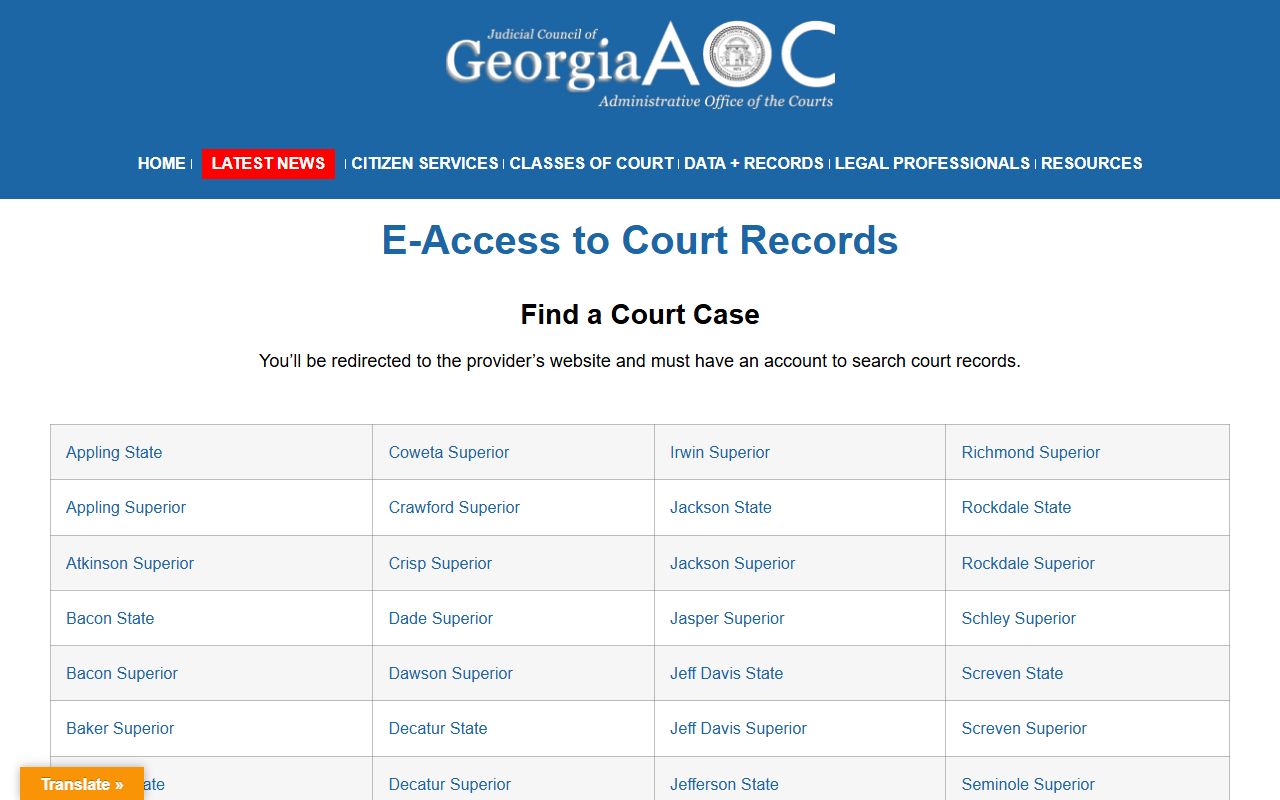
E-Access and the GSCCCA portal together cover most electronically filed Clayton County divorce cases, making online research a practical first step before visiting the courthouse.
How to Search Clayton Divorce Records Online
The Georgia Superior Court Clerks' Cooperative Authority at gsccca.org is the primary online search tool for Clayton County divorce records. You can search by name at no cost and get case numbers, filing dates, and docket information. Clayton County is a busy metro county, so the database is regularly updated and typically current within a business day or two of actual courthouse filings.
Georgia E-Access at georgiacourts.gov/eaccess-court-records/ provides a complementary view of Clayton County case data. Using both tools together gives you the broadest search coverage for cases filed in recent years. If both systems fail to return a result, consider that older cases may exist only in paper format, or that the case may have been filed under a slightly different name spelling.
Once you find the case number through online search, you can contact the clerk by phone or in person to order certified copies. Knowing the case number saves time and reduces the chance of confusion when clerk staff pull the physical file or electronic record. For cases that are entirely paper-based, staff will need to retrieve the file from storage, which may take additional time.
Note: The Clayton County clerk handles a large volume of requests, so mail requests may take longer than in-person requests. Plan accordingly if you need copies quickly.
Clayton County Divorce Filing Process
All Georgia divorces go through the Superior Court under O.C.G.A. § 19-5-1. Clayton County's Superior Court with its Family Division handles the full range of divorce cases from simple uncontested filings to complex custody and property disputes. The Family Division's structure helps manage the volume of domestic cases efficiently, though wait times for hearings can still run several months in contested matters.
Filing venue is determined by O.C.G.A. § 19-5-2, which requires filing in the county where the defendant lives. If your spouse lives in Clayton County, Jonesboro is where you file. For cases where both spouses live in the county, this is clear. When residency is uncertain or the other party has moved out of state, a brief review with an attorney helps confirm the right venue.
The process involves filing the petition, paying the filing fee, and serving the defendant through the county sheriff or a process server. A 30-day response window follows service. Uncontested cases with a complete settlement agreement can often be finalized soon after that period. Contested cases may require mediation, which Clayton County encourages as a first step before scheduling a trial, discovery exchanges, and hearings before the judge.
Georgia's grounds for divorce under O.C.G.A. § 19-5-3 include both no-fault and fault-based options. The no-fault ground of irreconcilable differences is the overwhelming choice in Clayton County and across the state, since it requires no proof of misconduct and streamlines the process considerably.
Fees for Clayton County Divorce Records
Copy fees at the Clayton County clerk depend on whether you need a plain copy or a certified copy. Plain copies are cheaper. Certified copies carry the court seal and official signature, making them valid for legal purposes. Contact the clerk at (770) 477-4565 for the current fee schedule. For a high-volume county like Clayton, fees may be updated more frequently than in smaller counties, so always confirm the amounts before you go.
The Georgia DPH Vital Records office at dph.georgia.gov/VitalRecords offers a $10 divorce verification for cases from 1952 through 1996. This is a confirmation letter confirming the divorce is on record, not a copy of the decree. For Clayton County divorces in that date range, the DPH verification is a fast way to get basic confirmation. Under O.C.G.A. § 31-10-22, the county clerk reports finalized divorces to DPH monthly.
If you need the full certified decree for a legal transaction, DPH is not sufficient. Go to the Superior Court Clerk for certified copies. In-person service is generally fastest for Clayton County given the clerk's capacity, though the office does accept mail requests with the right information and payment enclosed.
Note: Clayton County's filing volume is high, so building in extra lead time for any record request is advisable if you are working toward a deadline.
Legal Resources in Clayton County
Georgia Legal Aid serves Clayton County residents who qualify based on income. Their attorneys handle divorce, custody, child support, protective orders, and related family law matters. Clayton County's proximity to Atlanta means Legal Aid has a relatively strong presence in the area, and appointments can sometimes be arranged with shorter waits than in rural areas.
The Georgia State Bar's lawyer referral program connects Clayton County residents with a local family law attorney for a reduced-cost initial consultation. The Jonesboro area has a range of private attorneys handling divorce cases, and the metro Atlanta market overall offers competitive options. Even a single consultation before you file can prevent costly procedural mistakes down the road.
Pro se litigants are common in Clayton County courts, especially for uncontested cases. Georgia E-Forms through the state judicial website provides free templates for uncontested divorce petitions, settlement agreements, and final orders. The clerk's office can point you to the correct forms and explain the filing steps. Clayton County also has community legal clinics that occasionally offer family law guidance, so checking with local nonprofits and bar association programs is worth the effort.
Divorce Certificates in Clayton County
Georgia does not issue traditional divorce certificates the way some states do. What you can get from the Clayton County Superior Court Clerk is a certified copy of the final divorce decree. This document carries the court's official seal and signature and is accepted by virtually all agencies and institutions that need proof of divorce. A plain copy works for personal records but cannot be used in legal transactions.
The Georgia DPH verification for 1952-1996 divorces is a narrower document. It confirms that the divorce is on record in the state database and provides basic identifiers like names and date. It does not include property settlement terms, custody arrangements, or other substantive content from the decree. For many purposes, this is not enough.
To get what you need from Clayton County, contact the Superior Court Clerk at 9151 Tara Boulevard in Jonesboro. You can visit in person during business hours or submit a written request by mail. Include the full names of both parties, the approximate year of the divorce, and any known case number. Attach payment and a return envelope if mailing your request. For legal, financial, or government purposes, certified copies are the right choice every time.
Nearby Counties
Clayton County is in the south metro Atlanta area. If a divorce case may have been filed in a bordering county, these links will help you find the right records office.