
Search Lamar County Divorce Records
Lamar County divorce records are maintained by the Superior Court Clerk in Barnesville and cover all divorce cases filed within the county. If you need a certified copy of a final decree, want to look up an older filing, or are trying to confirm the status of a case, this guide covers every method for accessing Lamar County divorce records through online tools, the Barnesville courthouse, and mail-in requests.
Lamar County Quick Facts
Lamar County Superior Court Clerk
The Lamar County Superior Court Clerk in Barnesville maintains all divorce case records for the county. From the petition through the final decree and any post-judgment modifications, the clerk's office is the official repository. You can visit during business hours, call for information about mail requests, or search online before making any trip to Barnesville.
Georgia's open records statute at O.C.G.A. § 50-18-70 makes court records accessible to the public. No legal reason is required to request a divorce record. Sealed files are the only exception, and they are rare in family law matters. The clerk can immediately tell you whether a particular file is open for public access or has any restrictions.
| Court | Lamar County Superior Court |
|---|---|
| Address | 326 Thomaston Street, Barnesville, GA 30204 |
| Phone | (770) 358-5145 |
| Hours | Monday through Friday, 8:00 AM to 5:00 PM |
| Website | https://www.lamarcountyga.gov/ |
The courthouse is on Thomaston Street in Barnesville. Lamar County is a smaller county south of Atlanta, and the clerk's office handles records requests routinely. Calling ahead before a visit is always smart, particularly for older records that may require time to retrieve from the archive.
The image below is from the Lamar County government website, which provides links to the Superior Court Clerk and other county resources.
Access clerk contact details and county resources at lamarcountyga.gov for Lamar County divorce records information.
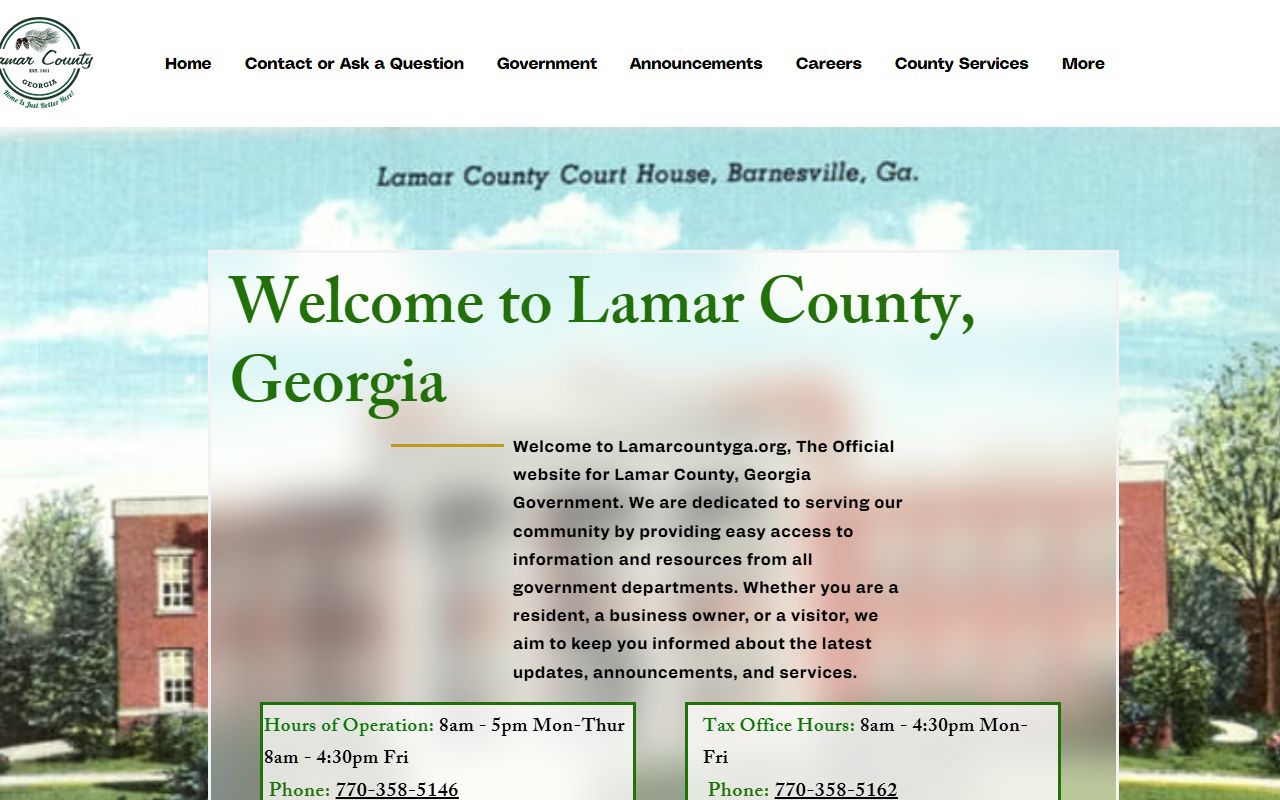
The Lamar County Superior Court Clerk's office in Barnesville is the official source for all Lamar County divorce case records and certified copies.
How to Search Lamar County Divorce Records
Start with the Georgia Superior Court Clerks' Cooperative Authority at gsccca.org. This free statewide portal lets you search Lamar County records by party name or case number. Results show filing dates and case status. If you locate the case number online, you can request documents more efficiently when you contact the clerk.
Georgia E-Access at georgiacourts.gov/eaccess-court-records/ is a second online resource for Georgia court records. Some counties provide more detailed data through E-Access than through GSCCCA. Checking both takes only a few minutes and increases the likelihood of finding what you need.
For Lamar County records that predate electronic indexing, direct contact with the clerk is necessary. Provide party names and an approximate filing year. Staff will search the paper archive. Older records may take a business day or more to retrieve, especially if they are stored off-site or in older filing systems.
Mail requests are processed regularly by the clerk's office. Include the party names, estimated year, the type of copy needed, and payment in the form of a money order. Confirm current fees and mailing instructions by calling (770) 358-5145 before sending your request.
Note: If you are searching for a case involving someone who may have used a different name at the time of filing, search both possible names through the GSCCCA system.
Lamar County Divorce Filing Requirements
Georgia's residency requirement under O.C.G.A. § 19-5-2 mandates that at least one spouse must have lived in Georgia for six months and in Lamar County for at least thirty days before filing the divorce petition. This rule determines which county has jurisdiction over the case. Filing in the wrong county can cause the case to be dismissed or transferred.
Georgia recognizes both no-fault and fault grounds for divorce under O.C.G.A. § 19-5-3. The no-fault ground of irretrievable breakdown of the marriage is the most widely used option across Georgia, including Lamar County. It does not require proving specific acts of misconduct. The fault grounds, which include adultery, desertion, and cruel treatment, are available but are used less often because they require proof and can prolong proceedings.
Once the petition is filed, the other party must be served. The Lamar County Sheriff, a private process server, or a voluntary service waiver can be used. After service, the respondent has thirty days to answer. Georgia law then imposes a mandatory thirty-day waiting period before the court can enter the final decree. These timelines apply in all cases, even when both parties fully agree on all terms.
Note: Lamar County Superior Court handles all divorces filed in the county as part of its exclusive family law jurisdiction under Georgia law.
Copy Costs for Lamar County Divorce Records
Copy fees at Lamar County Superior Court are set by the clerk's office and typically follow standard Georgia rates. Plain copies run a few cents to about a dollar per page. Certified copies carry an additional charge and include the clerk's seal. Certified copies are usually required when presenting a divorce decree to a government agency, financial institution, or another court.
For older divorces between 1952 and 1996, the Georgia DPH provides verification searches at $10 per request through dph.georgia.gov/VitalRecords. This is a summary-level record that confirms a divorce occurred and provides the date and county but does not include the terms of the court order. It is a useful lower-cost option for basic confirmation needs.
For all other purposes and for divorces after 1996, the Lamar County clerk is the source. Confirm current fees by calling (770) 358-5145 before sending payment. Fee schedules change occasionally, and confirming avoids having to resubmit a request due to underpayment.
Legal Help in Lamar County
Lamar County residents who want to handle their own divorce can find official, approved forms at the Georgia Courts E-Forms portal at eforms.georgiacourts.gov. These forms are designed for uncontested cases where both parties agree on all terms. They are free, court-approved, and appropriate for simple divorces without contested property or child issues.
Georgia Legal Aid at georgialegalaid.org offers free or low-cost legal services to income-qualified Georgia residents. The online application helps determine eligibility. If direct legal assistance is available in your area, Legal Aid staff can help with forms, court appearances, or advice on your rights under Georgia divorce law.
For contested cases, a licensed family law attorney provides the most reliable guidance. Lamar County is located in a judicial circuit that includes nearby counties, and attorneys familiar with the Barnesville courthouse and local procedures can be found through the State Bar of Georgia's referral service.
Divorce Decrees and State Vital Records
Two kinds of official records document a Georgia divorce. The Lamar County Superior Court decree is the primary legal document, containing all terms ordered by the judge. It is the document required for most official purposes: proving a divorce to a government agency, changing a name, or remarrying. Certified copies are available from the clerk in Barnesville.
The Georgia DPH maintains a statewide divorce index under O.C.G.A. § 31-10-22. This is a statistical record submitted by counties to the state. It shows the date and county of the divorce but does not include the terms of the court order. The DPH record is appropriate for genealogical research and basic confirmation of historical events but is not adequate for most legal purposes.
If you are unsure which document you need, the certified court decree is the safer and more complete choice for any official purpose. The DPH record is a good supplement but should not replace the certified decree when terms matter.
Nearby Counties
Lamar County is located in central Georgia south of Atlanta. Cases filed near county lines may have been recorded in one of the neighboring jurisdictions below.