
Stewart County Divorce Records
Stewart County divorce records are held by the Superior Court Clerk in Lumpkin, one of the smaller courthouses in southwest Georgia. This page covers how to search those records, request certified copies, and use both the local clerk and statewide Georgia resources to find what you need.
Stewart County Quick Facts
Where to Get Stewart County Divorce Records
The Stewart County Superior Court Clerk in Lumpkin keeps all divorce records for cases filed in the county. Stewart County is one of Georgia's smaller counties by population, so the clerk's office handles a modest volume of cases. Staff can still assist you with document requests, certified copies, and record searches during regular business hours.
Georgia's Open Records Act at O.C.G.A. § 50-18-70 makes divorce records public by default. Any person may request access to a divorce file unless a judge has specifically ordered it sealed. Sealing is uncommon. For cases that are open, both parties and third parties may request copies.
| Court | Stewart County Superior Court |
|---|---|
| Address | 176 Broad Street, Lumpkin, GA 31815 |
| Phone | (229) 838-6220 |
| Hours | Monday through Friday, 8:00 AM to 5:00 PM |
| Website | https://www.stewartcountyga.gov/ |
Lumpkin is a small town, and the courthouse is easy to find in the downtown area on Broad Street. Because this is a low-population county, the clerk's office staff are familiar with local records and can often assist visitors quickly. Call ahead before visiting, especially for older records that may be stored in archives rather than in active filing systems.
The image below shows the Georgia E-Access court records portal at georgiacourts.gov/eaccess-court-records/, a statewide tool for searching court case data including Stewart County filings.
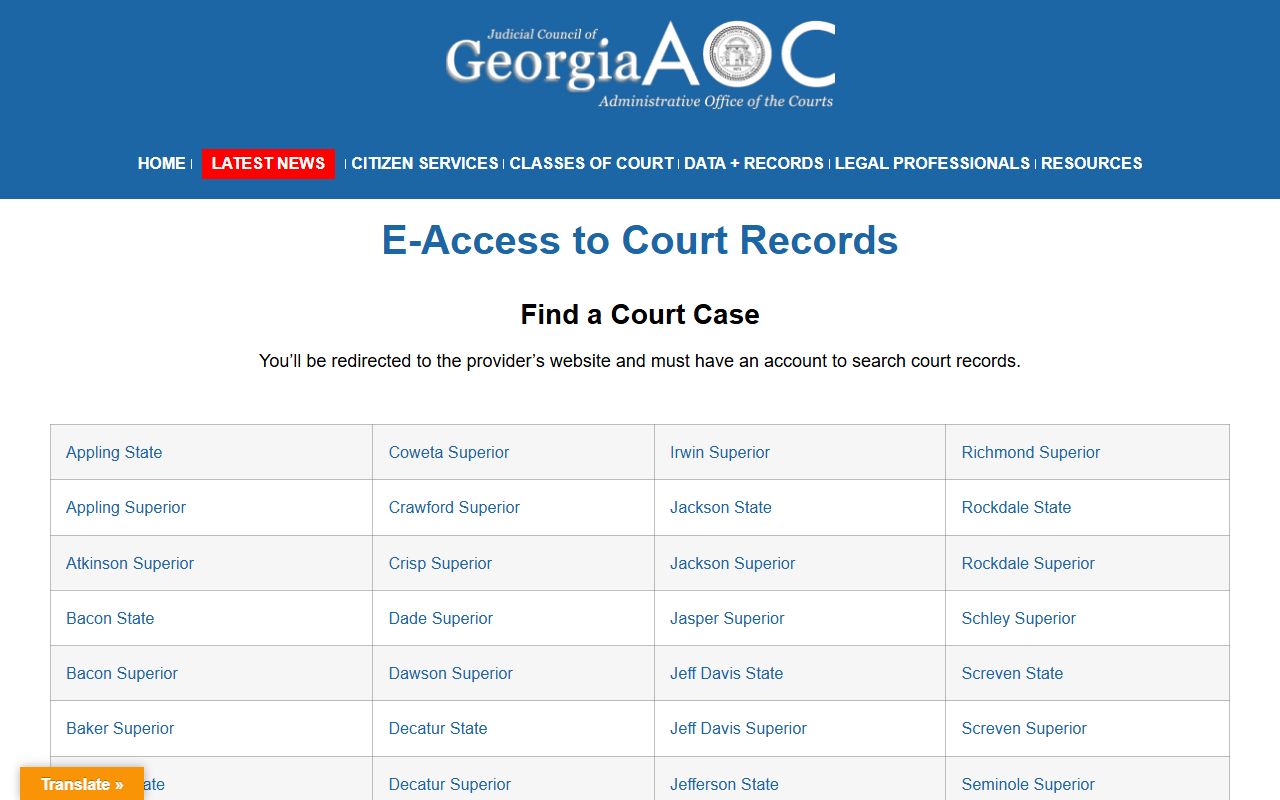
The E-Access portal aggregates case data from participating Georgia superior courts and is searchable by party name or case number.
Note: Small county clerks may have limited staff, so mail requests may take longer than in larger counties. Calling first can prevent wasted trips or delayed responses.
Searching Stewart County Divorce Records Online
The GSCCCA statewide index at gsccca.org includes Stewart County divorce filings. You can search by party name at no cost and see filing dates, case numbers, and basic case details. The GSCCCA portal is the easiest starting point for online research and does not require an account.
Georgia E-Access at georgiacourts.gov/eaccess-court-records/ provides another layer of case data. For Stewart County, where physical file retrieval may take a little extra time, knowing the case number from an online search before you contact the clerk can speed up the request process significantly. Both systems update regularly but may lag a few days behind new filings.
For very old cases that predate digital records, only a physical file exists. Written mail requests to the clerk's office at 176 Broad Street work for these situations. Include the names of both parties and the approximate year of the divorce in your letter. Adding a self-addressed stamped envelope helps speed the response.
Stewart County Divorce Filing Process
Georgia law under O.C.G.A. § 19-5-1 gives exclusive divorce jurisdiction to the Superior Court. The Stewart County Superior Court in Lumpkin handles all divorce cases filed in the county. No lower court can grant a divorce in Georgia.
Venue rules under O.C.G.A. § 19-5-2 require filing in the county where the defendant lives, with some exceptions. If your spouse lives in Stewart County, you file here. If your spouse has left Georgia and has no residence in the state, you may file in the county where you live. The clerk can answer basic questions about which county has proper venue, but complex venue issues may need an attorney.
After the defendant is served, Georgia requires a 30-day waiting period before the court can finalize the divorce. This gives the defendant time to respond. In uncontested cases, the parties often reach an agreement before or during this window, and the judge can sign the decree shortly after the 30 days are up. Contested matters take longer.
Under O.C.G.A. § 19-5-3, Georgia allows both no-fault and fault-based divorce. Irreconcilable differences is the most common ground used today. Fault grounds exist but require additional evidence at trial. Once the decree is signed and filed, it is a permanent public record with the Stewart County clerk.
Fees for Stewart County Divorce Record Copies
The Stewart County clerk sets copy fees in line with Georgia standards. Certified copies of divorce decrees carry the court seal and the clerk's signature and cost more than plain copies. For most legal purposes, a certified copy is what you need. Plain copies are useful for personal reference only.
Georgia DPH at dph.georgia.gov/VitalRecords provides $10 divorce verifications for cases from 1952 through 1996. This is a separate service from the court clerk. The DPH verification confirms the divorce and its date but does not include the full decree text. If you need the actual terms of the divorce, you must order a certified copy from the Stewart County clerk.
Call (229) 838-6220 to confirm the current fee before you visit or mail payment. As a small county office, Stewart County's fee structure is generally straightforward, but it can be adjusted by administrative order at any time.
Legal Resources for Stewart County Residents
Georgia Legal Aid serves Stewart County as part of its southwest Georgia coverage area. Residents with limited income can get free or low-cost help with divorce filings, name changes, and related domestic matters. More information and an online intake form are at georgialegalaid.org.
The Georgia E-Forms project at eforms.georgiacourts.gov offers free official forms for uncontested divorce cases. In a small county like Stewart, many divorces are uncontested, and these forms make self-filing straightforward. The forms include the petition, a settlement agreement template, and a final order form. They are updated by the Georgia court system and are accepted by clerks across the state.
The Georgia State Bar's lawyer referral service can connect you with an attorney if your case is more complicated. Even in rural areas like Stewart County, attorneys who practice family law in the Southwest Georgia judicial circuit are available. A single consultation can clarify whether your situation needs professional help or can be handled with the free forms.
Note: Under O.C.G.A. § 31-10-22, the Stewart County clerk sends monthly divorce reports to DPH, which is how the state verification database stays current.
Divorce Decrees vs. State Certificates
The decree is the full court order. It contains every term of the divorce, signed by the judge. Certificates are shorter records that just confirm the event. Georgia uses a verification system for state-level records rather than a true certificate format.
For most uses, you need the certified decree from the Stewart County clerk, not a DPH verification. The Social Security Administration, the DMV, financial institutions, and passport agencies typically require the certified decree. A DPH verification suffices only when you simply need to confirm the divorce occurred and are not required to show the terms.
If you are not sure which county holds the record you need, the GSCCCA statewide search at gsccca.org can point you to the right county. Once you know the county, you can contact that clerk directly for a certified copy.
Nearby Counties
Stewart County sits in southwest Georgia near the Alabama border. Each neighboring county maintains its own Superior Court divorce records.